

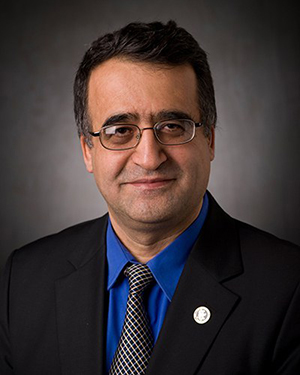
Ali Demirci, Ph.D.
Professor of Agricultural and Biological Engineering; Graduate Studies Committee Chair; Professor-in-Charge of the CSL Behring Fermentation Facility
Dr. Ali Demirci has been a pioneer in Pulsed Light (PL) research for more than two decades. A professor of Agricultural and Biological Engineering at Penn State University, he has published extensively on food safety and non-thermal decontamination technologies and holds several patents. Recently, he contributed a chapter on “Pulsed UV” to the new book entitled “Nonthermal Processing Technologies for Food”, which explores innovative approaches to food safety in modern production systems.
In this conversation, Dr. Demirci discusses his latest work, what makes Pulsed Light uniquely promising, and why the food industry should consider adopting this technology.
Q: Tell us about the new book and the chapter you’ve written for it.
Dr. Demirci: The book brings together leading experts in food safety to highlight emerging non-thermal technologies and how they can make food processing more efficient and sustainable. My chapter focuses on Pulsed Light applications in food production based on the research we’ve done at Penn State. We’ve studied its use on fresh produce, ready-to-eat foods, liquid products, and food-contact surfaces. We’ve also studied packaging materials, an area where Pulsed Light has real promise. This is a technology that offers unique advantages, and our research shows that it can be used successfully in many areas of food production.
Q: What first drew you to Pulsed Light technology?
Dr. Demirci: When I joined Penn State in 1999 as an assistant professor, my position focused on microbiologicaly engineering and food safety. At that time, thermal technologies dominated the field—they worked well for decontamination, but they often changed the quality of the food.
I became interested in non-thermal technologies, and Pulsed Light caught my attention. What excites me most is that Pulsed Light is non-thermal, non-chemical, and dry—no water, no chemical residues, and no heat when used correctly. It can be extremely fast; we’ve shown in research that Pulsed Light can achieve effective decontamination in just a few seconds, depending on the application.
Q: Where can Pulsed Light be used in food processing?
Dr. Demirci: Pulsed Light can be used on conveyor systems, packaging, and even with some foods. It’s best suited for surface applications because light doesn’t penetrate deeply into solid foods.
We’ve done studies on blueberries and raspberries, and the inactivation rates have been very good. Pulsed Light also works well with clear liquids—it can penetrate effectively and kill microorganisms quickly without raising the temperature. We even did a study on individually wrapped cheese slices to see if Pulsed Light could pass through the film and still treat the cheese inside—and it did. That’s very encouraging.
One of our most successful projects has been treating the surface of eggs during processing. Working with an egg producer, we designed a conveyor-based Pulsed Light system that integrates easily into existing washing and grading operations. This work shows that Pulsed Light can be adapted for high-volume, continuous processing—an important milestone for real industrial use.
Q: You mentioned packaging as a promising area—can you explain?
Dr. Demirci: Packaging is where a lot of contamination happens, right before or right after the food is sealed. Pulsed Light is a great fit there. It can be applied to plastic or paper packaging, and it’s already showing strong potential. I believe packaging applications may be the fastest path for industry adoption because they’re simpler, cleaner, and easier to standardize than treating foods directly.
Q: Do you ever collaborate with food companies to explore applications?
Dr. Demirci: Every time we publish new research, companies reach out to see if Pulsed Light could fit into their production lines. Some of those conversations have grown into direct collaborations, where we’ve worked together to test Pulsed Light systems on specific products or develop custom setups for pilot-scale trials.
These partnerships are essential. When industry and research work together, we can tailor the technology to each company’s process and demonstrate that PL is both practical and effective.
Q: What would you say to food companies hesitant to try something new?
Dr. Demirci: I’d say that Pulsed Light is safe, proven, and sustainable. It eliminates pathogens without chemicals, without heat, and without water. It’s also a great way to build public trust—to show customers that you’re investing in new technologies to make food safer. Companies that lead in this area have a chance to stand out.
Editor’s Note: Dr. Ali Demirci’s ongoing research continues to expand the applications of Pulsed Light in food and packaging safety. To learn more about the XENON Pulsed Light systems used in his research, contact XENON today.